Search Intent Mapping: How to Align Every Page with What Your Audience Actually Wants
Search intent is the single most important factor determining whether a page will rank for its target keywords. Modern search algorithms no longer reward keyword repetition alone — they prioritize contextual alignment between the query and the page's true purpose.
Google has become extremely sophisticated at distinguishing between informational, navigational, commercial, and transactional queries. Pages that clearly satisfy the underlying user objective consistently outperform pages that merely include the keyword without fulfilling intent.
Intent alignment is the foundation of sustainable ranking performance and higher conversion efficiency.
Understanding the Four Core Search Intent Types
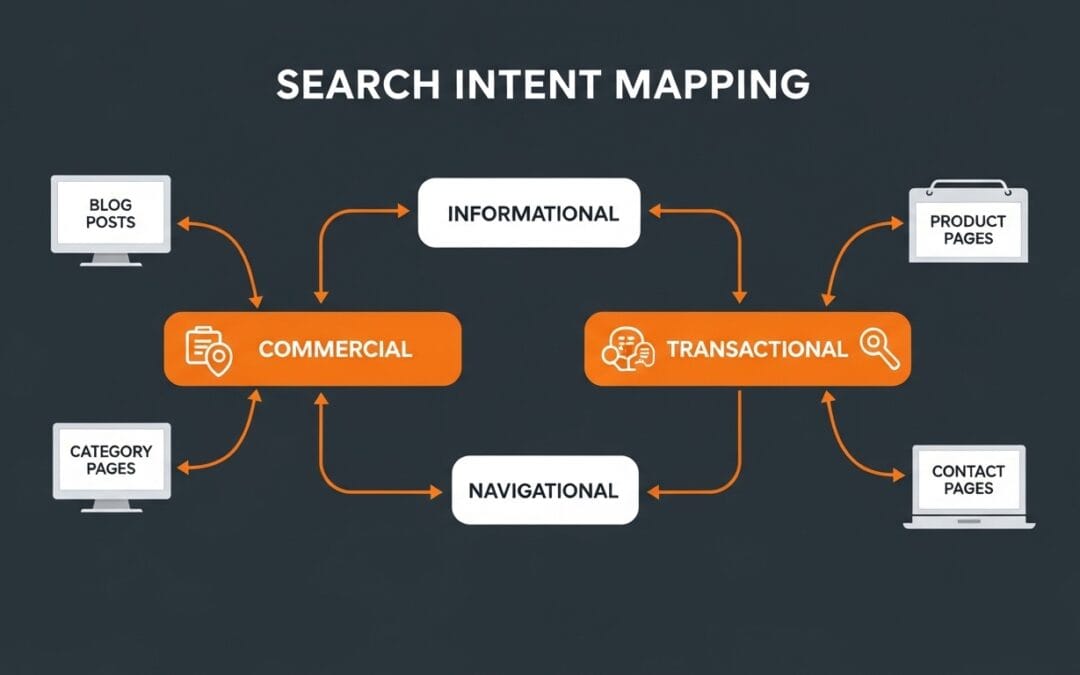
Informational — Users seek knowledge or answers.
Navigational — Users are looking for a specific brand or website.
Commercial Investigation — Users compare options before purchasing.
Transactional — Users are ready to take action or buy.
Each intent category requires a distinct content structure. Informational queries demand depth and clarity. Commercial queries require comparison frameworks and trust indicators. Transactional queries prioritize frictionless UX and persuasive elements.
Mapping Intent Across Your Content Architecture
Effective intent mapping begins with clustering keywords based on purpose rather than search volume alone. Pages should be designed around the decision stage the user is currently in, ensuring logical progression across your site.
Align blog content with informational intent
Design service pages for commercial evaluation
Optimize landing pages for transactional completion
Strengthen internal linking between intent stages
Restructuring Pages for Intent Precision
Many ranking failures occur because the content format does not match the searcher's expectation. A long-form guide cannot satisfy a transactional query. A product page cannot fully answer informational research queries.
Restructuring involves revisiting headings, rewriting introductions to clarify purpose, and adjusting calls-to-action so they correspond with the user's mindset at that moment.
When every page clearly satisfies a defined intent category, ranking consistency and engagement metrics improve simultaneously.
Frequently Asked Questions
Search intent refers to the underlying goal a user has when typing a query into a search engine. Google's algorithm is designed to identify and match that goal with the most relevant results. Pages that accurately fulfill the user's intent — in format, depth, and content type — consistently outrank pages that only match the keyword. Understanding and satisfying search intent is now the foundational requirement for sustainable rankings.
The most reliable method is to analyze the top-ranking results for a keyword in Google. Look at the type of content (blog post, product page, video, landing page), the format (how-to guide, list, comparison), and the angle (beginner overview vs. advanced deep-dive). These patterns reveal what Google believes users want. Additionally, the keyword's modifiers — words like "best," "how to," "buy," or "near me" — are strong signals of the underlying intent category.
In most cases, a single page should be designed around one primary intent. Trying to serve multiple conflicting intents — for example, combining a long educational guide with aggressive transactional CTAs — often results in mixed signals that dilute ranking performance and reduce user satisfaction. However, some commercial intent pages can successfully incorporate informational elements to build trust before conversion, as long as the primary purpose remains clear.
A page that mismatches search intent will struggle to rank regardless of its technical optimization or backlink profile. Even if it temporarily ranks, it will likely experience high bounce rates, short dwell times, and low engagement — all behavioral signals that tell Google the page is not satisfying users. Over time, Google will demote it in favor of pages that better fulfill the query's purpose. Intent misalignment is one of the most common and overlooked causes of ranking stagnation.
Search intent maps almost directly onto the buyer's journey. Informational intent corresponds to the awareness stage — users are discovering a problem or topic. Commercial investigation intent aligns with the consideration stage — users are evaluating options. Transactional intent reflects the decision stage — users are ready to act. Mapping content to each stage ensures your site captures users at every point in their journey and guides them progressively toward conversion.
Search intent can shift over time as user behavior and Google's understanding of queries evolve. A quarterly review of your most important pages is a reasonable baseline. Prioritize pages experiencing ranking drops or traffic declines, as intent drift is frequently the cause. When Google updates its algorithm, re-check your top-performing pages against current SERP results to confirm the intent your content satisfies still matches what Google is rewarding.